
Regime Change
In the Time of Monsters

Perry Anderson’s London Review of Books post entitled Regime Change in the West? provides an impressive survey of neoliberalism past and present. The article starts by outlining how neoliberalism emerged from the various crises faced by Keynesianism in the 1970s eventually gaining dominance across the globe over the following twenty five years. During this period, debt played a central role in supporting the system both domestically within nations and globally. Neoliberalism should have folded after the 2008 Financial Crash. However emergency surgery applied at the time by its global backers via Quantitative Easing allowed it to continue living on for two primary reasons: 1) No alternative theoretical paradigms were advanced to dislodge neoliberal doctrine, 2) No signification political movements calling robustly for the abolition or radical transformation of capitalism.
Centre-right and centre-left parties conspired either side of 2008 to maintain neoliberal system with slightly different variants. One variant was disciplinary more associated with the centre-right offering austerity. The other variant was compensatory offering side-payments to the poor associated more with centre-left.
Until 2015 there remained little significant opposition to the status quo of bailouts, austerity and growing inequality. From that point on, though, populism emerged major political force fuelled by Brexit, Trump and Covid. Anderson suggests it was a response to the three major principles of modern neoliberalism namely: a) inequality, or “escalatory differentials in wealth and income”, b) oligarchy, or the “abrogation of demarcation control and representation”, c) factor mobility, the free mobility of goods, services, capital and labour across national boundaries which is a key hallmark of globalisation.
Anderson asserts that these have become the key targets of populist insurgents but with different emphases depending on the source of the populism. Inequality and to a lesser extent oligarchy are targets for both left and right forms of populism. However factor mobility in the guise of immigration is uniquely a target of right populists. Left populism has no real answer to it. That’s why right populists are winning. Anderson doesn’t mention growing concerns around resource depletion, climate change and biodiversity collapse at all which seems a major omission. Neither neoliberalism not populism appear to have any answers for that. He does reference regime change in China suggesting that if current crisis persists, it could lead to similar conditions arising in the West. Such a scenario could break the tenacious hold of capitalist realism, puncturing the belief that “there is no alternative”, ushering in another regime change, post-neoliberalism.
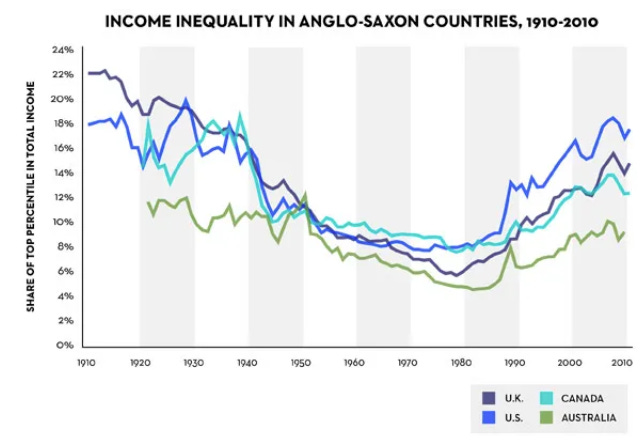
What follows is a ChatGPT Deep Research article that was generated using my notes written after reading the article. Those notes are broadly as presented above. I have only made a handful of changes to the output text notably integrating references inline, removing bold and italicised text within paragraphs and adding a graph. Otherwise, what follows is long read that was generated by an AI not by me. While informative, it feels a bit disjointed and jerky in tone. There are rather a lot of hyphens, brackets and bullet points even after the removals. The concluding section feels laboured and a little repetitive with too much Gramsci methinks. Even so, it feels important to explore whether AI Deep Research can help me to be creative with my writing and to document my attempts. In doing so I am inspired by Venkatesh Rao’s Sloptraptions newsletter where he is experimenting with protocols for article generation based on guided input. Consider this a far more basic experiment in form. The prompt was little else beyond my notes and I provided no steer in terms of tone or editorial style. It doesn’t read like anything I’ve written and there are likely tools that can confirm that. Even so, it’s very impressive that an article of this detail can be created this way from a few sentences of input when as little as three years ago, it would have been firmly considered to be magic.
The Survival of Neoliberalism: Crisis Without Transition
Introduction: An Era That Just Won’t End
Neoliberalism has dominated global economics and politics for the last few decades. It’s the market-centric creed that triumphed in the late 20th century – yet even after multiple crises and growing discontent, it remains strangely tenacious. In this AI-generated deep dive, we’ll explore what neoliberalism really means, how it differs from older liberal ideas, and why it has survived even as its contradictions fuel a wave of populism. We’ll see how debt became neoliberalism’s lifeline, why the 2008 financial crash didn’t kill it, and how the populist uprisings of recent years (from Brexit to Trump) reflect a crisis without transition. Throughout, we’ll draw on thinkers like Antonio Gramsci, David Harvey, and Thomas Piketty to make sense of a world where the old order is dying, but a new one has yet to be born.
What Is Neoliberalism? Key Features of the Creed
Neoliberalism is more than just free-market economics – it’s a whole philosophy about how society should be organized. Emerging in the late 20th century, neoliberalism rebooted classic liberal ideas for the modern age. Its key features include:
Market Fundamentalism: The belief that free markets are the best (and even only) way to organize almost all areas of life. Competition, supply-and-demand, and prices are treated as the guiding principles for everything – from the cost of bread to the value of a college degree. Every problem, in this view, has a market solution.
Individual Responsibility: Neoliberal ideology puts the onus on individuals to succeed or fail. People are seen as entrepreneurs of their own lives – responsible for their education, employment, health care, and welfare. If someone is struggling, the assumption is they must adapt, retrain, or work harder, rather than expect social support. This goes hand in hand with a disdain for collective solutions or strong labor unions.
Deregulation and Privatization: Governments are urged to “get out of the way” of the private sector. Neoliberal policies slash regulations on businesses, banks, and environmental protections, arguing that this unleashes innovation and growth. Public services and industries are privatized wherever possible – from national airlines to water supply – on the premise that the private sector is more efficient.
Fiscal Austerity: Neoliberalism favors cutting public spending, especially on social programs. Taxes on corporations and the wealthy are reduced, and welfare budgets are tightened in the name of “fiscal responsibility.” The goal is a leaner state that intervenes less in the economy. Margaret Thatcher’s government in the UK (1979–1990) was emblematic: she cut taxes, deregulated industries, privatized state-owned companies, and weakened the power of trade unions. Ronald Reagan undertook similar measures in the U.S. These policies aimed to revive economic dynamism by empowering businesses and investors.
Free Trade and Globalization: Neoliberalism enthusiastically promotes free trade agreements and globalization of production. Removing tariffs and barriers allows capital and goods to move freely across borders. Corporations can offshore factories to wherever labor is cheapest, and finance can flow unimpeded. The idea is that global competition allocates resources efficiently. But this also means jobs can vanish overseas and economies become more exposed to global market swings.
In short, neoliberalism envisions a world where market logic governs every aspect of life. As one critic put it, under neoliberal norms “competition is the only legitimate organising principle for human activity”. Society becomes a giant marketplace, and humans become rational, self-interested actors by assumption. This marks a profound shift from earlier mid-20th-century ideas of collective responsibility and social safety nets.
Neoliberalism vs Classical Liberalism: What’s “Neo” About It?
It’s easy to confuse neoliberalism with the classical liberalism of the 18th and 19th centuries (think Adam Smith or John Stuart Mill). Both champion free markets and individual liberty. But neoliberalism is not just a revival of laissez-faire – it’s a reinvention that actively uses state power to expand markets. This is the crucial difference:
Classical liberalism (laissez-faire) largely wanted the state to leave markets alone. The motto was literally “laissez-nous faire” (“let us do [as we please]”). Merchants and industrialists asked only for minimal government interference – just protection of property rights and maybe basic public order. The ideal was a night-watchman state that kept out of economic affairs, on the belief that markets naturally self-regulate.
Neoliberalism, in contrast, recognizes that markets aren’t truly “natural” and often need to be actively created and enforced by governments. As historian Quinn Slobodian and others have noted, neoliberals understood that left to themselves, societies might choose welfare, equality, or protectionism – so the state must be re-engineered to prioritize market relations. In the words of one analysis: Classical liberals said “leave us alone,” but neoliberals say the state must set the stage for markets to rule. That means passing laws, crafting institutions, and even using force if necessary to ensure that competition and private enterprise can penetrate all areas of life.
Put simply, classical liberalism wanted a minimal state, whereas neoliberalism seeks a market-maximizing state. Neoliberals don’t hesitate to use government to break labor unions, deregulate industries, privatize assets, enforce contracts, protect investors, and bail out finance in a crisis. All these require strong state action. Paradoxically, neoliberalism can lead to more state intervention – but always on behalf of market principles, never against them. As the Marxist geographer David Harvey observed, neoliberalism isn’t about shrinking the state per se; it’s about repurposing the state to serve the interests of capital and restore the power of economic elites. In Harvey’s view, this political project explains why neoliberal policies so often favor corporations and the wealthy at the expense of workers.
From Stagflation to Thatcher: Neoliberalism’s Rise in the 1970s
How did neoliberalism become the reigning ideology? Its ascent was not inevitable – it was a response to the dramatic crises of the 1970s that unraveled the post-WWII economic order. After World War II, most Western nations followed a Keynesian model: governments actively managed the economy, pursued full employment, invested in social welfare, and kept finance on a tight leash. This “postwar consensus” delivered a generation of growth and broadly shared prosperity. But by the late 1960s and 1970s, storm clouds gathered:
Stagflation: The postwar boom turned into a bust. A mix of factors – the U.S. spending on Vietnam, rising oil prices, and more – led to high inflation plus stagnant growth in the 1970s. This dreaded combo (stagflation) confounded Keynesian economics, which had assumed inflation and recession couldn’t happen simultaneously. Traditional Keynesian stimulus (more public spending) only seemed to stoke prices further.
Oil Shocks: In 1973, OPEC nations embargoed oil, quadrupling prices virtually overnight. Another oil shock followed in 1979 after the Iranian Revolution. These crises sent inflation soaring to double digits and triggered recessions. Long lines at gas stations and spiraling costs became symbols of governments’ inability to manage the economy.
Fiscal Crises and Unemployment: Governments that had built welfare states suddenly faced budget crises. Unemployment climbed along with inflation – something thought impossible under Keynesian theory. Faith in the old economic consensus was badly shaken. In the famous phrase of British PM Margaret Thatcher, there was a growing sense that “there is no alternative” (TINA) but to try something new.
Enter a new generation of political leaders inspired by free-market intellectuals like Friedrich Hayek and Milton Friedman. In the late 1970s and early 1980s, they seized the moment:
Margaret Thatcher’s Election (1979): In the UK, Thatcher campaigned on breaking the vicious cycle of strikes, inflation, and “decline.” Once in power, she implemented monetarist policies (tight control of money supply to curb inflation), slashed the power of labor unions (famously crushing the miners’ strike), privatized national industries, removed exchange controls, and preached self-reliance. The British welfare-state consensus was upended by her neoliberal revolution. “Economics are the method,” Thatcher said, “the object is to change the soul” – reflecting her aim to instill entrepreneurial values in society.
Ronald Reagan’s Victory (1980): In the United States, Reagan likewise rode a wave of discontent to the presidency. He cut top marginal tax rates dramatically, deregulated airlines and trucking, fired striking air-traffic controllers (signaling organized labor was in his crosshairs), and embraced free trade and globalization (under Reagan, the U.S. supported the creation of the WTO’s predecessor agreements). His brand of neoliberal policy was nicknamed “Reaganomics” and featured the idea of trickle-down economics – that making the rich richer would eventually benefit everyone.
Across the World: Similar shifts happened elsewhere. Chile had already undergone a harsh neoliberal experiment after General Pinochet’s coup in 1973 (with Chicago-trained economists designing radical privatization programs). In the 1980s, countries like New Zealand (under Roger Douglas) and Canada (under Brian Mulroney) also pivoted to free-market reforms. By the 1990s, even left-of-center leaders like Bill Clinton and Tony Blair embraced key neoliberal tenets – liberalizing finance, signing free trade deals (NAFTA, EU’s single market), and proclaiming “the era of big government is over.” The Soviet Union’s collapse (1991) further cleared the field, leaving market capitalism with no serious ideological rival on the world stage.
Thus, neoliberalism emerged from the 1970s crisis as the “new common sense”. It presented itself as the solution to stagflation and economic malaise: tame inflation with tight monetary policy, unleash growth by freeing markets, and let globalization and innovation lift all boats. For a while, it seemed to work – inflation subsided by mid-1980s, and the late 1980s and 1990s saw robust growth and the end of the Cold War, which neoliberals hailed as a vindication of free-market democracy (“the end of history,” in Francis Fukuyama’s famous phrase). But there was a dark side to this apparent triumph, one that would become more evident over time.
The Debt Engine: Neoliberalism’s Hidden Lifeline
Neoliberalism preached discipline – balanced budgets, limited government, personal responsibility. Yet ironically, debt became the fuel that kept its engine running, both in rich countries and globally. With wages stagnating for many and public spending curtailed, the system found ways to keep consumption and investment going through borrowing. Two critical mechanisms were:
Privatized Keynesianism (Domestic Debt): The term “privatized Keynesianism” (coined by political economist Colin Crouch) captures how, in many Western countries, private credit replaced public spending as the way to stimulate demand. Under the old Keynesian model, if the economy slumped, governments might go into deficit to build a bridge or hire teachers – injecting purchasing power into households. Under neoliberalism, such counter-cyclical public spending was discouraged (seen as wasteful or inflationary). Instead, policymakers tolerated – even encouraged – a boom in private debt: ordinary people borrowing on credit cards, auto loans, and especially mortgages. Deregulation of finance made credit widely available. In the U.S., the financial sector innovated new products (subprime mortgages, home equity loans) that effectively let families borrow against rising housing prices to maintain their living standards even as real wages flatlined. This was the era of “shop till you drop” fueled by credit cards, and using one’s home like an ATM. It propped up consumer demand and thus economic growth – a private-sector echo of the stimulus that government deficits used to provide. The catch, of course, was that it left households heavily indebted and fragile. The 2008 financial crisis would later expose how unsustainable this private debt binge had been.
Debt as Discipline (Global South): Neoliberal globalization came with strings attached for developing countries. In the 1980s, many countries in Latin America, Africa, and parts of Asia fell into debt crises (often worsened by the high interest rates set by U.S. Fed Chair Paul Volcker to crush inflation in the early ’80s). The International Monetary Fund (IMF) and World Bank stepped in with rescue loans – but conditional on structural adjustment programs. These programs required debtor nations to implement classic neoliberal policies: privatize state industries, cut social spending, open up to foreign trade and investment, deregulate markets, and weaken labor protections. In effect, debt became a lever to impose neoliberalism on reluctant societies. Countries like Mexico, Brazil, and Nigeria, in exchange for loan restructuring, had to accept what later became known as the Washington Consensus – a one-size-fits-all menu of market reforms. Critics like Naomi Klein (in The Shock Doctrine) noted that these indebted nations lost a degree of sovereignty; their economic policy was now dictated by creditors in Washington. Debt was used as a disciplinary tool: fall in line with market fundamentalism, or face default and economic collapse. The result for many was painful – increased poverty and inequality – but it did succeed in spreading neoliberalism’s reach worldwide by the 1990s.
In wealthy countries, another kind of discipline emerged: governments, fearing backlash from bond markets, embraced austerity to keep debt and inflation low. Meanwhile, central banks kept money cheap (low interest rates) which further encouraged private borrowing. David Harvey quipped that under neoliberalism, “we live beyond our means via credit, but within our means when it comes to social support.” In other words, we’ve been individually loaded up with debt while public goods are starved.
2008: Crisis Yet No Transition (Why Neoliberalism Survived the Crash)
By the mid-2000s, the cracks in neoliberalism were showing. Soaring inequality, precarious jobs, housing bubbles, and an overgrown financial sector set the stage for a meltdown. In 2008, it happened: the U.S. housing bubble burst, giant banks failed, and the global financial system nearly collapsed. Many expected this would finally bury neoliberalism. After all, here was a crisis born directly from deregulation and Wall Street excess. Surely a return to more regulated, Keynesian economics (or something more radical) was inevitable?
Yet, astonishingly, neoliberalism survived. Governments did intervene – but largely to save the existing system, not remake it. A famous quip after 2008 was, “We’re all Keynesians in a foxhole.” Indeed, the U.S. and UK governments bailed out banks with taxpayer money, and China launched a massive stimulus. Central banks slashed rates to zero and printed money (quantitative easing) to prop up markets. These were emergency Keynesian-style actions, but crucially they were done to rescue neoliberal capitalism itself – not to replace it. Once the worst passed, business mostly continued as usual. Why?
No Organized Alternative: Unlike in the 1930s, when the Great Depression led to the rise of revolutionary ideologies (socialism, fascism, etc.) and the New Deal, in 2008 there was no cohesive alternative vision ready to go. The mainstream center-left (e.g. Democrats in the U.S., Labour in the UK) had long since absorbed neoliberal thinking (remember, it was Bill Clinton who deregulated Wall Street further in the 90s). There was no strong socialist or social-democratic movement with a fleshed-out program waiting in the wings. Some ideas like tighter bank regulation or progressive taxation were floated, but no country undertook a wholesale paradigm shift. Margaret Thatcher’s old dictum – “There Is No Alternative” (TINA) – still seemed to haunt policymakers.
Intellectual Hegemony: Neoliberal ideas had become deeply entrenched in elite institutions – finance ministries, central banks, universities, media. Immediately after 2008, there was soul-searching among economists, but the fundamental curriculum in economics departments didn’t radically change. Many technocrats doubled down on certain neoliberal prescriptions (for example, insisting on austerity cuts to public spending in countries like Greece and Spain as soon as the initial crisis subsided). The argument was that government debt itself had become the new threat (despite private banks causing the mess). Lacking a new theory, leaders fell back on what they knew. In the Eurozone, this led to harsh austerity measures that prolonged misery but aligned with neoliberal fiscal orthodoxy.
Political Fragmentation: While public anger at “banksters” and inequality was high, it was diffuse. There were protests – Occupy Wall Street in 2011 demanded to hold the “1%” accountable – but these movements, lacking organization and clear demands, fizzled without achieving policy changes. Unlike the labor movements of the early 20th century, the post-2008 protesters didn’t coalesce into a political force capable of seizing state power or writing new laws. Meanwhile, the beneficiaries of neoliberalism (financial elites, corporate lobbyists) fought hard to prevent any structural reforms. The result was a grudging stabilization: banks were saved, some regulations tightened around the edges, but the overarching system of globalized, financialized capitalism remained intact.
In 2011, British academic Colin Crouch aptly titled his book The Strange Non-Death of Neoliberalism. The beast lived on, even after having seemingly blown itself up. For ordinary people, however, something had fundamentally shifted. The post-2008 recovery was lopsided: stock markets rebounded and billionaires multiplied, but many workers faced unemployment, stagnant wages, or lost homes. This cumulative resentment set the stage for the political earthquakes to come.
Populism Strikes Back: The 2010s Revolt Against the Elites
By the mid-2010s, disillusionment with business-as-usual started to boil over. Neoliberalism had promised prosperity and freedom; instead, many citizens felt they got inequality, precarity, and loss of control over their lives. This brewing anger found expression in a wave of populist insurgencies across the Western world, taking various forms but sharing a common target: the established political-economic order.
Starting around 2015, these shocks came in rapid succession:
Brexit (2016): In a stunning referendum result, British voters chose to leave the European Union – defying the advice of nearly the entire political and economic establishment. Regions left behind by globalization and austerity strongly backed Brexit, propelled by slogans like “Take Back Control.” It was partly a rejection of EU neoliberal policies (free movement of labor and capital) and partly fueled by nationalist nostalgia. Immigration, a visible aspect of globalization, became a flashpoint: Leave campaigners blamed migrants for job competition and strained services. Brexit was a populist cry of anger against distant elites (Brussels technocrats, London bankers) by those who felt unheard.
Donald Trump’s Election (2016): Across the Atlantic, American voters sent an outsider to the White House. Trump railed against free trade deals (calling NAFTA the worst in history), promised to bring back manufacturing jobs, and spoke to the economic grievances of once-prosperous industrial regions (“the Rust Belt”). At the same time, he used openly nativist and anti-immigrant rhetoric – vowing to build a wall on the Mexican border and ban Muslim immigrants. This combination of economic nostalgia and ethnonationalism proved effective. Trump’s victory was a loud rejection of both traditional Republican plutocracy and Democratic neoliberalism. Many of his voters were the “losers” of globalization who felt abandoned by elite consensus policiestheguardian.com.
Left-Wing Populism (Syriza, Sanders, Corbyn): Not all populism tilted right. In Greece, the Syriza party (led by Alexis Tsipras) swept to power in 2015 on a vow to defy EU-imposed austerity – effectively a revolt against neoliberal fiscal strictures. In Britain, Jeremy Corbyn took over the Labour Party (2015) with an energizing anti-austerity, democratic-socialist platform that galvanized young voters. In the U.S., Bernie Sanders (though ultimately unsuccessful in winning the presidency) mounted a serious challenge to establishment Democrats in 2016 and 2020 with calls for Medicare for All, free college, and higher taxes on billionaires. These left populists directly attacked neoliberal inequality and proposed expanding the welfare state and reining in corporate power.
Five Star and Others: In Italy, the Five Star Movement and in Spain, Podemos, rose from fringe movements to major parties by channeling frustration at corruption and economic stagnation. Even in traditionally stable countries like France, populist fervor grew – from the right (Marine Le Pen’s National Front tapping into anti-EU, anti-immigrant sentiment) and from grassroots protests like the Gilets Jaunes (Yellow Vests) who in 2018 erupted against fuel taxes and the urban elites.
COVID-19 Pandemic (2020): The coronavirus crisis was not a populist movement, but it acted as an accelerant and a revealing stress test. The pandemic forced massive state intervention (lockdowns, stimulus spending) that temporarily suspended some neoliberal norms. It also further polarized politics – some right-wing populists downplayed the virus or protested health mandates as elitist plots, while others used the crisis to argue for reshoring production (e.g., making masks and medicines domestically rather than relying on global supply chains). The pandemic’s economic fallout once again hit the most vulnerable the hardest, likely fueling more anger at the status quo.
Underpinning these populist waves were three key contradictions of neoliberalism that had reached breaking point:
Inequality and Oligarchy: Decades of neoliberal policy had undeniably led to a concentration of wealth at the top. As economist Thomas Piketty famously documented, since about 1980 the share of income and wealth going to the richest 1% (and 0.1%) has skyrocketed in the U.S., UK, and elsewhere. Meanwhile, middle-class incomes stagnated and secure jobs gave way to gig work and outsourcing. Voters sensed – correctly – that the system was rigged in favor of a globalized elite. Populists tapped into resentment of billionaires, bankers, and political dynasties. Trump, paradoxically a billionaire himself, ran against “elites” and promised to “drain the swamp.” Brexit campaigners argued EU membership only benefited London financiers. This anti-oligarchy sentiment was potent, even if the populist leaders did not always follow through on economic reforms.
Loss of Sovereignty (Real or Perceived): Neoliberal globalization meant national governments often ceded decision-making to transnational forces – be it the EU bureaucracy, trade agreement rules, or simply the pressures of international markets. Many citizens felt their democracy had been hollowed out – that no matter who they voted for, the real decisions were made by “technocrats” and CEOs. This fed a desire to “take back control” – a phrase that resonated beyond Brexit. Populists offered to reassert the nation’s autonomy: put “America First,” or prioritize “Italians first,” etc. This often entailed scapegoating external forces like immigrants or foreign countries.
Factor Mobility – Especially Immigration: One aspect of neoliberal globalization is the free movement of factors of production – capital and labor – across borders. Corporations could relocate factories overseas (capital mobility), and workers could migrate more easily in many regions (labor mobility). Both trends created a backlash. Right-wing populists found particular success focusing on immigration (labor mobility). They linked rising diversity and inflows of migrants to economic woes and cultural anxiety. In reality, immigrants often contributed more in growth, but the perception (fueled by some media) was that they take jobs, depress wages, or strain welfare. This anti-immigrant stance proved electorally powerful – arguably more so than abstract talk of inequality. Meanwhile, left-wing populists tended to focus on capital mobility – criticizing trade deals that enable offshoring, or tax havens that let the rich hide wealth. While both issues are important, controlling immigration is a simpler rallying cry to mobilize voters, compared to explaining complex financial flows. This asymmetry partly explains why right populism has outpaced left populism in victories. Far-right leaders promise quick fixes (build a wall, exit the union, ban imports) whereas left populists propose systemic changes (redistribute wealth, regulate finance) that face fiercer opposition from entrenched interests.
Notably, populism is not inherently a left or right phenomenon – it’s a style of politics that pits “the people” against “the elite.” The right-wing version has been more electorally successful in recent years, especially in countries like the U.S., Poland, Hungary, Brazil, and the UK. These right populists often accept many neoliberal economic ideas (low taxes, deregulation) but combine them with nationalist and authoritarian tendencies – a mix sometimes dubbed “authoritarian neoliberalism.” They focus on cultural issues, identity, and border control, co-opting the anger while leaving the economic structure largely intact. Left populists, on the other hand, directly challenge economic power structures (banks, corporations) and advocate expanding public services. But they face enormous resistance from the business class and often get painted as “radical socialists” in mainstream discourse, which can scare off moderate voters. For example, Jeremy Corbyn’s bold manifesto in 2019 (renationalizing railways, taxing the ultra-rich) was attacked vehemently by the press and many in his own party, contributing to his defeat.
By 2020, the political landscape in many democracies had been profoundly reshaped by this populist surge. Yet for all the turbulence, neoliberalism still had not been dethroned. Instead, it was like a wounded giant – limping along, contested at the ballot box, but still setting many of the rules of the game, especially in the economy. Which brings us to our current situation: a crisis of the old order, without a clear new order to replace it.
Interregnum: Crisis Without Transition
Italian Marxist Antonio Gramsci, writing in the turmoil of the 1930s, coined a famous concept of interregnum – a time when the old world is dying and the new cannot yet be born. In that interregnum, he said, a great variety of morbid symptoms appear (or as it’s often paraphrased, “now is the time of monsters”). Many observers feel that this is exactly where we stand today. Neoliberalism’s legitimacy has been deeply eroded – by financial crashes, by obscene inequalities (captured in images of plutocrats flying to Davos in private jets while middle-class families struggle), and by its inability to address emergent crises like climate change. And yet, no cohesive successor has emerged. We are essentially in a “crisis without transition.”
What does this mean?
Neoliberalism Wounded but Alive: The institutions, trade treaties, and corporate dominance built under neoliberalism are still largely in place. Global capital still moves freely; tech giants and financial firms still operate in a lightly regulated environment; many policymakers still default to market solutions. But the confidence and optimism of the 1990s are gone. Faith in the neoliberal “Washington Consensus” has even waned among some elites. For instance, the IMF has started to acknowledge that inequality can hurt growth, a mild heresy against earlier dogma. Yet in practice, the changes to the model have been minor. It’s as if everyone knows the system isn’t truly working for the majority, but no one in power can agree on (or risk) a wholesale overhaul.
Populism as a Partial Remedy – or Illusion: The populist movements provided a vehicle to vent frustrations, and in some cases to enact policy shifts (e.g., Trump did withdraw the U.S. from certain trade deals and implement tariffs; some Eastern European governments have defied EU liberal norms). However, populism has not (yet) delivered a coherent new economic paradigm. In some cases, it has degenerated into authoritarianism or cronyism – channeling anger toward minorities or sidelining democratic checks and balances, without empowering the masses economically. Brazil’s Bolsonaro, for example, talked like a populist but governed with many neoliberal policies and left office with inequality still high. Brexit has so far not revived UK communities in the way its proponents promised. The left-populist experiments, like Syriza in Greece, hit a wall when faced with global market realities (Greece had to capitulate to EU austerity in 2015 when threatened with banking collapse). In short, populism has highlighted the failures of neoliberalism but not solved them.
The Ecological Reckoning: Looming above all is the climate and ecological crisis. This might be the ultimate challenge that neither neoliberalism nor simplistic populism can master. Neoliberalism’s answer to climate change has been woefully inadequate – relying on market mechanisms (like carbon trading or green tech financed by venture capital) that have not cut emissions nearly fast enough. Populists, especially on the right, often outright deny the climate problem or dismiss it in favor of jobs and nationalism. Yet the laws of physics are immune to political ideology. As climate-fueled disasters intensify and scientists’ warnings grow ever more dire, the pressure for a new mode of economic organization will only increase. A system premised on infinite growth, consumerism, and laissez-faire can’t easily cope with the need to rapidly decarbonize and possibly constrain growth for sustainability. Some thinkers advocate a “Green New Deal” – massive public investment in clean energy and jobs, harking back to Keynesian ideas but for ecological ends – which would be a departure from neoliberal orthodoxy. Whether such ideas gain traction may determine if we navigate the coming storms or not.
In Gramsci’s words, “The old is dying and the new cannot be born; in this interregnum a great variety of morbid symptoms appear.” We see those morbid symptoms in resurgent nationalism, conspiracy theories, democratic backsliding, and public despair. Yet there are also signs of hope: fresh thinking on the economy (for instance, movements for worker co-ops, community wealth building, or Piketty’s proposals for participatory socialism), and younger generations that are both tech-savvy and socially conscious, demanding action on climate and inequality.
The story of neoliberalism’s survival thus far is a cautionary tale about how hard it is to dislodge a deeply entrenched regime, even after it fails spectacularly. As David Harvey might remind us, entrenched class interests and ideology don’t just give up – they regroup. After 2008, neoliberalism regrouped. After the populist shock of 2016, it’s again adapting (notice how even big corporations now talk about “inclusive capitalism” and diversity – surface concessions to maintain a broader system). But can it survive the triple onslaught of populist anger, its own economic contradictions, and ecological meltdown?
Conclusion: The Crossroads – What Comes Next?
We stand at a crossroads. Neoliberalism, the once unassailable “idea that swallowed the world,” is now beleaguered – criticized from all sides, yet remains the default setting in so many ways. Populist revolts have cracked open the political map, but they have not definitively installed a new paradigm. There is no clear replacement on the horizon yet.
History suggests that no dominant economic order lasts forever. Feudalism gave way to capitalism; classical liberalism gave way to Keynesian welfare states after the 1930s; Keynesianism gave way to neoliberalism in the 1970s. Perhaps neoliberalism’s successor is incubating now in the minds of young economists, climate activists, and social movements worldwide. Will it be a revival of social democracy? Democratic socialism? Green-centric economics? Or something entirely novel enabled by technology (imagine decentralized finance, universal basic income, etc.)? It’s too soon to say.
In the meantime, we must navigate this interregnum wisely. That means addressing the legitimate grievances that fuel populism – the gross inequality (as Piketty’s work laid bare), the feeling of powerlessness among ordinary people, the cultural dislocation – without falling for the false solutions of demagogues. It means reforming capitalism to serve broader social and environmental goals, not just profit. It means rekindling a sense of collective purpose that neoliberal individualism eroded.
As citizens and readers, understanding the arc of neoliberalism – its rise, reign, and resilient survival – is crucial to shaping what comes next. We are living through history: a crisis without transition is an unstable equilibrium. Sooner or later, something has to give. The question is, will the transition (when it finally comes) lead us to a more equitable, sustainable order – or something darker?
In this “time of monsters,” to recall Gramsci, our task is to push for the birth of a new world before the old one drags us all down with it. Neoliberalism may have survived for now, but its future is not guaranteed. And as the cracks widen, the urgency grows for fresh ideas that can guide a true transition – to an economy that values not just markets, but humanity and the planet we share.